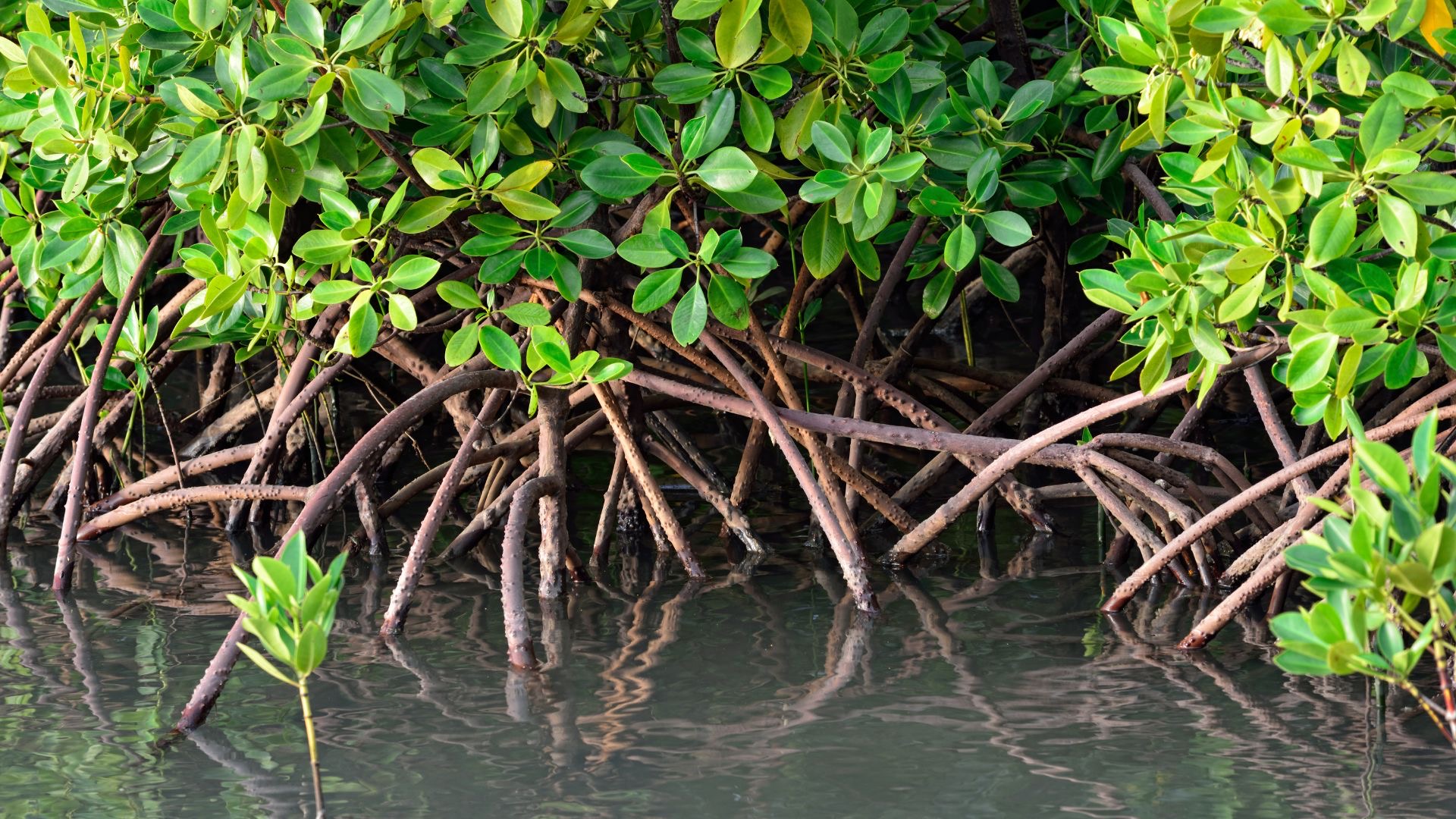
Seeing Mangrove Restoration as a Living System
Mangrove restoration is more than planting saplings. It is about understanding how tides, soil, biodiversity, communities and continued monitoring work together over time. Drawing from a field visit to Gujarat, this blog reflects on what it takes to view restoration as a living, interconnected system.
Mangrove restoration sits at the intersection of climate action, community participation and biodiversity recovery. When planned and implemented well, its value extends beyond the number of saplings planted or hectares covered. It can contribute to coastal resilience, strengthen local participation, support livelihoods and create conditions in which biodiversity can recover.
The need for such restoration is becoming increasingly important. In 2024, the International Union for Conservation of Nature (IUCN) released its first global Red List of Mangrove Ecosystems, indicating that more than half of the world’s mangrove ecosystems assessed are at risk of collapse, with climate change among the major threats.
Mangroves help protect coastlines, reduce disaster risks, store carbon and support fisheries. This makes their conservation and restoration increasingly relevant not only ecologically, but also for CSR and climate-linked interventions seeking meaningful, long-term outcomes.
But plantation numbers tell only part of the story. The more important questions begin after planting. Are the saplings surviving? Are local conditions supporting their growth? Has the right species been planted in the right location? Is the community involved in protecting the site? And over time, are there visible signs of ecological recovery?
These questions became much more tangible during my recent visit to Tadatalav, Gujarat, as part of Project Vasudha, a collaboration between Dr. Reddy’s Foundation and Vertis Infrastructure Trust.
On paper, projects are often understood through plantation area, survival rates, blue carbon value and other reporting indicators. Walking through the muddy site, observing the plantation and speaking with the field team and project volunteers made me see how many factors sit behind those numbers.
Seeing Mangrove Restoration on the Ground
At Tadatalav, plantation undertaken during FY 2024–25 and FY 2025–26 showed encouraging signs of establishment. Across both phases, the reported average survival rate was around 85–90 per cent. In most patches, the saplings appeared healthy, with their growth and leaf condition indicating that they were establishing themselves in the local coastal environment.
Across the approximately 200-hectare plantation area, tidal movement plays an important role. Tidal inflow helps maintain soil moisture, influences salinity and supports nutrient movement. These may appear as technical parameters in a report, but their importance becomes much clearer in the field.
Restoration, therefore, has to work with the natural rhythm of the landscape.
The site also showed that restoration is rarely uniform. Some patches were growing better than others, reflecting differences in tidal exposure, soil conditions, waterlogging and salinity. Such variations make continued monitoring and, where required, gap filling or replantation important.
Tidal movement can also bring challenges such as waste accumulation, algal material and other disturbances that may affect plantation health. Regular field presence and monitoring therefore becomes important for identifying risks early and taking timely action.
What appears as a plantation in a report is much more dynamic on the ground. Tides, soil, species, monitoring and people are constantly interacting.
That was perhaps the clearest takeaway from the visit: the work does not end when a sapling goes into the ground. It is only then that the longer process of understanding and supporting a living system begins.
More Than Sapling Survival
One of the most encouraging observations was the presence of life around the plantation. Crabs and mudskippers moved through the mud, while birds and other coastal fauna were visible around the site. I would hesitate to draw conclusions from a single visit, but their presence was a useful reminder that the purpose of restoration extends beyond keeping planted saplings alive.
The longer-term question is whether the conditions necessary for a functioning ecosystem are gradually being restored
Communities are equally important to this process. People living around these landscapes understand seasonal changes, local risks and conditions that may not always be visible through periodic assessments. At Tadatalav, community involvement extends across plantation, monitoring, nursery support and site protection. This local participation can add continuity to mangrove restoration, particularly when projects need to be sustained well beyond the initial plantation phase.
The field visit also made me think more closely about how different elements of restoration depend on one another. Tidal flow can influence sapling health. Uneven growth can point to differences in soil or water conditions. Delayed monitoring can mean that gaps are identified later than they should be. Site protection, meanwhile, depends on regular field presence and community participation.
Seeing Restoration through a Systems Lens
Seen this way, restoration is an interconnected process involving ecology, people and implementation. Sapling survival, tidal conditions, species suitability, biodiversity, community participation and monitoring cannot be viewed entirely in isolation. A change in one can influence what happens elsewhere in the system.
For me, this is where field visits become particularly valuable. They connect indicators in a report with what is happening on the ground. A survival rate begins to reflect decisions around site selection, species, nursery practices and maintenance. An uneven patch becomes something to investigate rather than simply record.
For CSR and climate-linked restoration projects, plantation numbers remain important, but they become more meaningful when complemented by evidence on ecological outcomes, community participation, emerging risks, and corrective actions.
This creates a more complete picture of the intervention and can strengthen the way progress is understood, communicated and sustained over time.
Projects like these also bring together multiple perspectives.
Technical teams may focus on ecological suitability, species selection and survival. Communities understand local conditions, seasonal patterns and practical realities. CSR partners look for accountability, measurable outcomes and long-term value, while implementation teams work to translate these different priorities into meaningful action on the ground.
Each perspective adds something important to the restoration process.
This means translating what is happening in the field into meaningful learning: What is working? Where are risks emerging? What requires correction? What should be documented? And what constitutes credible evidence of progress?
A survival rate, therefore, is not simply a number. It can reflect site suitability, species selection, nursery quality, tidal conditions and maintenance. Similarly, weaker growth in a particular patch may indicate tidal stress, soil conditions, salinity, waterlogging or the need for timely intervention.
Connecting these perspectives helps make monitoring not only a tool for accountability, but also a means of learning and improving restoration over time.
Restoration Requires Continuity
Mangrove restoration therefore requires more than a successful plantation season. It requires continuity: observing what is changing, recognising risks early, listening to local knowledge and adapting where necessary.
My visit to Tadatalav reinforced a simple idea. Restoring an ecosystem is not about imposing a fixed plan on a landscape. It is about staying close enough to understand how that landscape responds and continuing to learn from it.
Ultimately, the question is not only whether mangroves have been planted successfully. It is whether restoration can remain technically sound, rooted in community realities, practical to implement and credible enough to create value over time. Perhaps that begins by treating the landscape as a living system to be understood, supported and sustained.
By
Evangelina Patro | Program Associate – ACE
Read More
Skill Development for Persons with Disabilities in India 2000 to 2026

AI and critical thinking in education: The Answer Came Too Easily