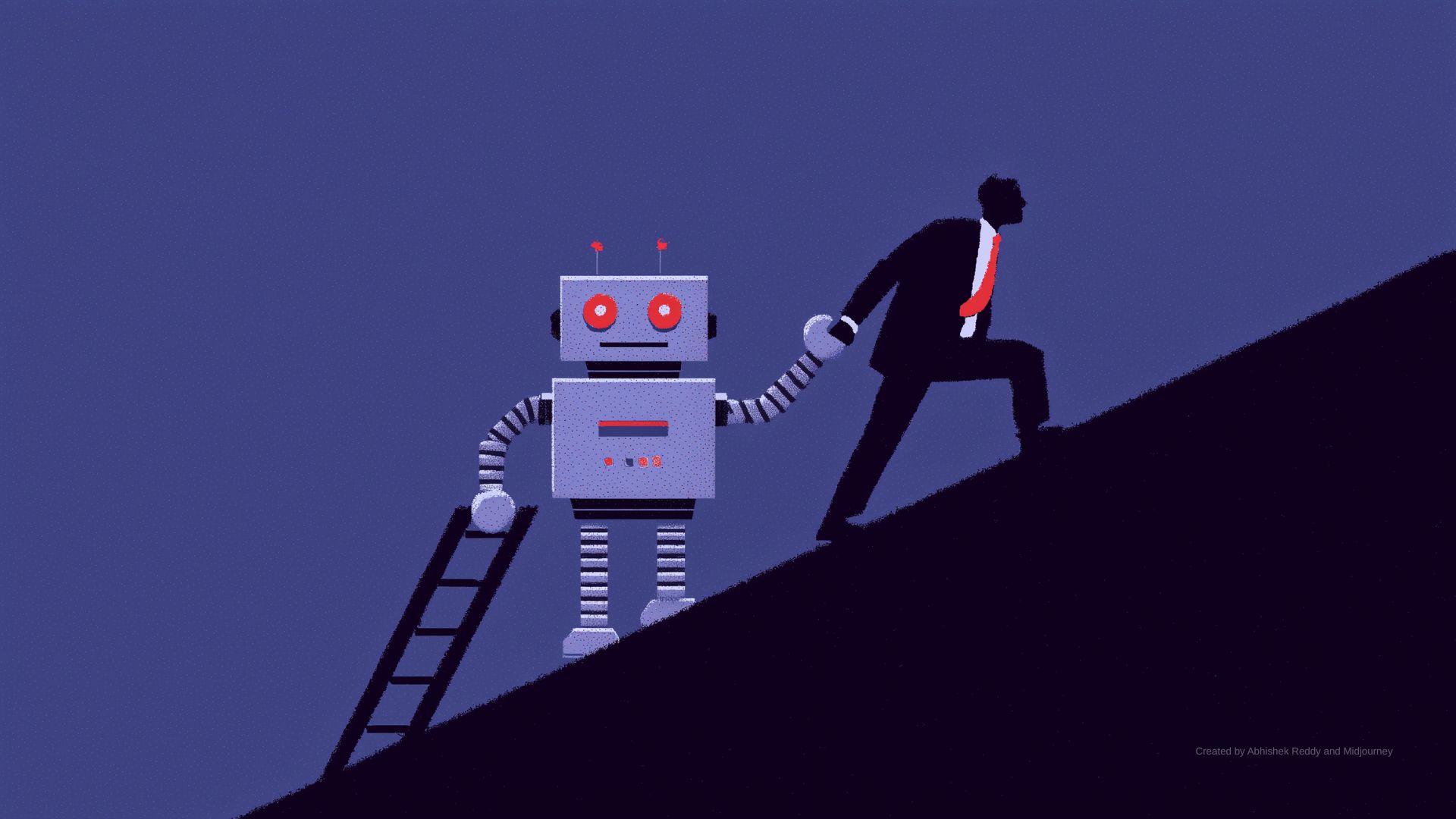
AI and critical thinking in education: The Answer Came Too Easily
AI and critical thinking in education are at the centre of this blog, which explores how easier answers can sometimes make real learning less visible. It looks at why struggle, confusion, and independent reasoning are essential to building true understanding. The piece argues that AI can support students well, but only when it sharpens their thinking instead of replacing it.
There was a time when getting stuck was part of studying.
A student would sit with a problem, stare at it, try one route, fail, try again, ask a friend, go back to the textbook, and slowly arrive at something that felt like an answer. Not always the perfect answer. But a hard-earned one.
That process was untidy. Sometimes frustrating. Often slow.
But it did something important. It made the mind work.
Today, artificial intelligence has changed that rhythm almost overnight. A difficult concept can be simplified in seconds. An essay can be drafted before the student has properly formed an opinion. A math problem can be solved with steps, examples, and explanations. The answer arrives quickly. Cleanly. Almost too politely.
And because the output looks impressive, it is easy to assume that learning has also happened.
That is where the illusion begins.
The shortcut problem
A recent survey by the Digital Education Council reported that 86% of students use artificial intelligence (AI) to finish their coursework, 54% use it weekly, and nearly one in four, daily.
Honestly, this should not surprise anyone.
Students are not behaving irrationally. They are responding to the tools placed in front of them. When something can summarise, draft, explain, translate, polish, and solve within seconds, why would a student not use it? Especially in a system that often rewards speed, submission, and marks more than the quality of thought behind the work.
The problem is not that AI makes learning faster. Speed is not the enemy.
The problem is that speed can quietly replace struggle. And struggle, uncomfortable as it is, has always been one of the main ways we learn to think.
That is why AI and critical thinking in education has become such an urgent conversation. The issue is not whether students should use AI. They already are. The real question is whether they are using it to think better, or to avoid thinking altogether.
These are very different things.
What getting stuck was doing
In education, we often speak about learning as if it is the same as receiving information. It is not.
Bloom’s Taxonomy gives us a useful way to understand this. Learning begins with remembering and understanding. Then it moves towards applying, analysing, evaluating, and finally creating. The higher levels are where real thinking begins. A student does not just know something. They can use it, question it, connect it, challenge it, and build something new from it.
But these higher levels are not reached by skipping the lower ones.
They are built through friction.
A student who struggles with a concept is not wasting time. They are forming connections. They are discovering what they do not know. They are learning to separate a weak answer from a strong one. They are building the mental habit of staying with difficulty instead of escaping it.
AI can interrupt this process if used passively.
Ask for a summary, and you get one. Ask for an essay, and you get a structure. Ask for an argument, and you get both sides neatly arranged. It feels like progress. But often, the student has only moved from not knowing to possessing an answer.
That is not the same as understanding.
The quiet loss no one sees
This is the uncomfortable part. The damage does not show up immediately.
Assignments are submitted. Grades may remain fine. Teachers may see polished work. Parents may feel reassured. Institutions may even report strong performance.
But something else can be hollowing out underneath.
According to Gerlich (2025), published in Societies (MDPI), a clear negative correlation was found between heavy AI reliance and critical thinking ability, particularly among younger students who have not yet developed strong foundational reasoning skills.
This matters because critical thinking is not a decorative skill. It is not something students need only for debates, essays, or exams. It is the ability to look at information and ask: Is this true? What is missing? What assumption is being made? What else could explain this? Is the answer convincing, or only well-written?
When AI repeatedly performs this work for the student, the student may lose the habit of doing it independently.
And the loss is subtle.
A student may still sound articulate. Their work may still look complete. Their answers may still be grammatically correct. But when faced with a new situation, a messy problem, or a question with no ready-made answer, they may struggle to begin.
Not because they are incapable.
Because the muscle was not used enough.
What AI and critical thinking in education must get right
None of this is an argument against AI.
In fact, used well, AI can be a remarkable learning companion. It can explain a concept in five different ways. It can give feedback without impatience. It can help a student from a small town access the kind of support that was once available only to those who could afford tutors, coaching, or elite schools.
That is powerful.
But the difference lies in the role AI is allowed to play.
There is a big difference between asking AI to explain why your answer is weak and asking it to write the answer for you. There is a difference between using it to test your understanding and using it to escape the discomfort of not understanding. There is a difference between treating it like a mirror and treating it like a substitute mind.
AI and critical thinking in education is not a debate between old-fashioned teaching and new technology. It is about protecting the part of learning that changes the learner.
Because the point of education is not simply to produce correct answers. It is to produce people who can think when the answer is not obvious.
The danger of identical thinking
There is another concern, and it is less discussed.
When many students ask similar questions to the same kinds of AI systems, the answers often begin to sound similar. The structure is similar. The tone is similar. Even the imagination becomes similar.
This creates a strange kind of uniformity.
Earlier, when students worked through an idea themselves, their answers carried traces of their own thinking. Some were clumsy. Some were sharp. Some went in unexpected directions. There was individuality in the attempt.
With passive AI use, that diversity can shrink.
Students may start with different minds and still arrive at nearly identical responses. The answer may be efficient, but it may not be theirs in any meaningful sense.
And if education loses originality, it loses something far deeper than marks.
It loses the ability to help young people form judgment.
The real question for AI and critical thinking in education
The question, then, is not whether AI belongs in classrooms. It already does. Trying to pretend otherwise is pointless.
The more useful question is this: what should students do before they turn to AI?
They should try first. Even badly.
They should write the rough version. Attempt the problem. Form an opinion. Make a mistake. Get confused. Sit with the confusion for a while.
Only then should AI enter the picture.
At that stage, AI becomes useful in a deeper way. It can challenge the student’s reasoning. It can point out gaps. It can offer another perspective. It can help refine the work. But the student is still present in the process. Their mind is still active.
That is the difference.
At its best, AI and critical thinking in education can sit together. AI can expand access, reduce barriers, and make learning more responsive. But it cannot replace the inner work of learning. It cannot do the student’s thinking and still leave the student stronger.
Because understanding is not something we download.
It is something we build.
Slowly. Unevenly. Sometimes painfully.
And if we remove every difficult step from learning, we should not be surprised when students know how to get answers but no longer know how to think their way towards them.
By
B SiriNikitha | Senior Executive, Communications
Read More

Skill Development for Persons with Disabilities in India 2000 to 2026

Seeing Mangrove Restoration as a Living System